The short answer
Three languages matter in Bali. Balinese (Basa Bali) is the mother tongue of most Balinese people, spoken at home, in the village and at the temple. Indonesian (Bahasa Indonesia) is the national language, used in schools, government, the media, business and between Balinese and the many Indonesians from other islands who live here. And English is widely spoken wherever tourists go: hotels, restaurants, dive shops, tour companies and most shops in the south and Ubud.
So you can travel Bali comfortably in English. But a few words of Indonesian, and even one or two of Balinese, will change the way people respond to you.
Balinese: the language of home and temple
Balinese is an Austronesian language, related to Indonesian, Javanese and Sasak on Lombok, but a separate language rather than a dialect. Indonesia's 2000 census counted around 3.3 million speakers, nearly all on Bali and in Balinese communities on Lombok and elsewhere.
What makes it fascinating, and famously tricky, is its system of speech levels. The words you use depend on who you are talking to and their social standing.
- Basa ketah or kapara, everyday "low" Balinese, used among friends, family and equals.
- Basa madia, a middle register for polite conversation with people you do not know well.
- Basa singgih or alus, refined "high" Balinese, used with priests, elders, people of high caste and in formal and ceremonial settings, much of it borrowed from Javanese.
Even Balinese speakers are not always fluent in the highest register, and in daily life many younger people switch freely between Balinese and Indonesian. Priests also use Kawi, an old literary form of Javanese, in rituals.
Balinese has its own beautiful script, aksara Bali, descended from Indian scripts and used on palm-leaf manuscripts for centuries. Under a 2018 provincial regulation on Balinese language, script and literature, government buildings, temples, tourist sites, roads and business signs are expected to show Balinese script alongside the Latin alphabet, and Governor Wayan Koster reaffirmed the rule for business nameboards in February 2026. Look up next time you pass a bank or a petrol station.
Indonesian: the language everyone shares
Bahasa Indonesia is the language you will actually find useful. It is the official language of the country, taught in every school, and nearly every Balinese person speaks it fluently. Taxi apps, menus, road signs, price tags and official notices are in Indonesian, often with English underneath in tourist areas.
Good news for visitors: it is one of the easier Asian languages to pick up. It uses the Latin alphabet, has no tones, no verb conjugations and no gendered nouns, and words are pronounced as they are written. A few pronunciation keys go a long way:
- c is said "ch," so Canggu is "Chang-goo" and cantik (beautiful) is "chan-tik."
- e is often a soft "uh," as in "selamat" (suh-LAH-mat).
- u is "oo," and every letter is pronounced.
Our Bahasa Indonesia 101 page has a fuller phrase list and pronunciation guide.
English: where it works and where it does not
In Seminyak, Canggu, Ubud, Sanur, Nusa Dua and Uluwatu, English is the working language of tourism. Hotel staff, drivers, surf instructors and guides usually speak it well, and many speak some Japanese, Mandarin, Russian or German too.
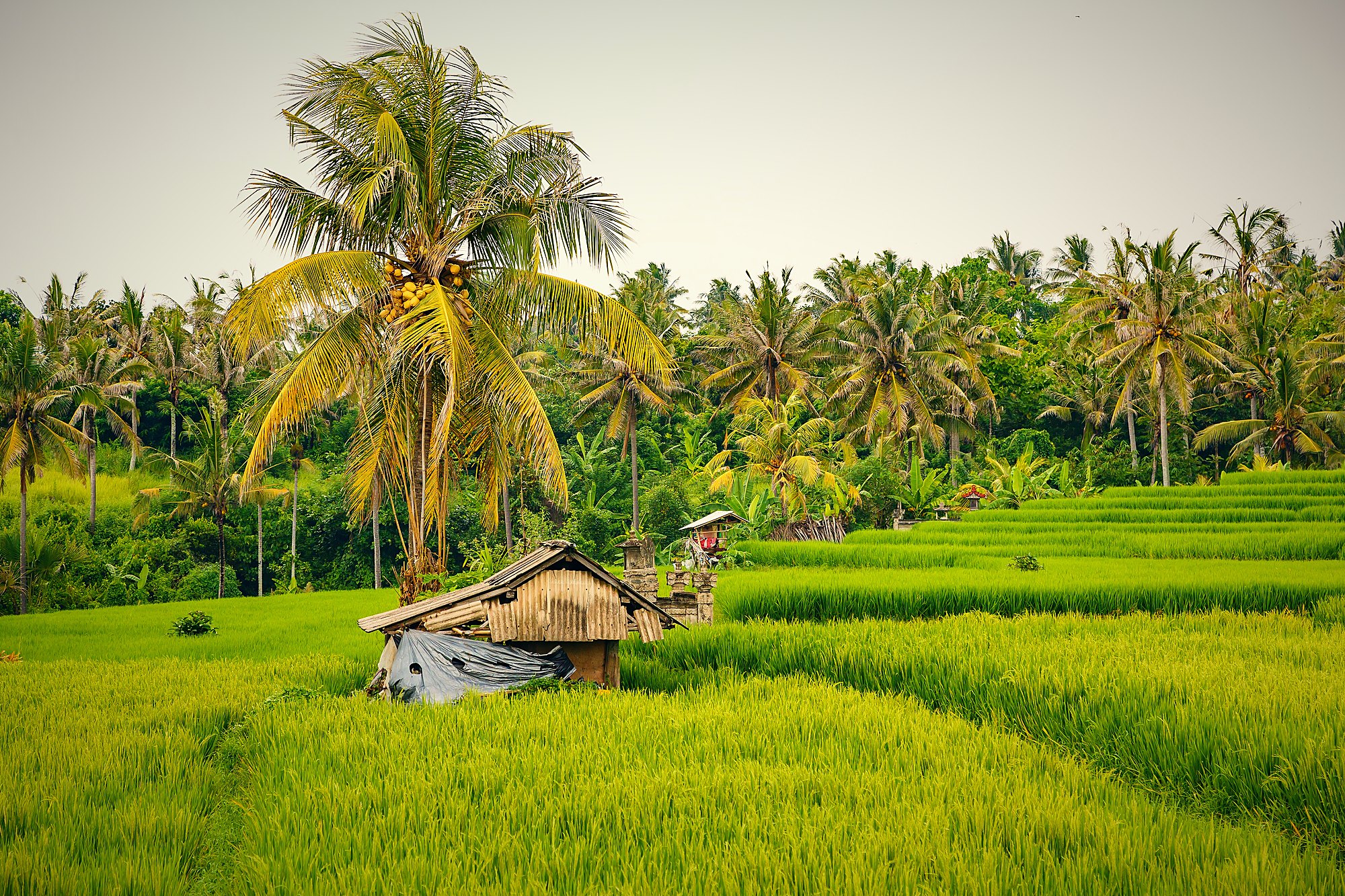
Head into the countryside, to rice-farming villages in Tabanan, the mountains around Munduk, the east coast near Amed or the north, and English thins out quickly. Older people, small warung owners and market sellers may speak little or none. Grab and Gojek drivers vary; translation apps fill the gap. This is exactly where a few Indonesian words turn a slightly awkward transaction into a smile.
Useful Indonesian phrases
- Terima kasih (tuh-REE-mah KAH-see): thank you
- Sama-sama: you're welcome
- Selamat pagi / siang / sore / malam: good morning / midday / afternoon / evening
- Permisi: excuse me, also used when passing someone or entering a shop
- Maaf: sorry
- Tolong: please (when asking for help)
- Berapa harganya?: how much is it?
- Bisa kurang?: can you lower the price? Useful at markets, always with a smile.
- Tidak, terima kasih: no, thank you, for hawkers and drivers
- Enak sekali: very delicious
- Tidak pedas: not spicy
- Di mana toilet?: where is the toilet?
Numbers are worth learning because prices have many zeros. Ribu means thousand, so "lima puluh ribu" is 50,000 rupiah. Many people simply say the number and drop the "ribu," so "dua puluh" for a coconut means 20,000.
A few words of Balinese
Using Balinese, even badly, delights people because visitors almost never try.
- Om Swastiastu: the traditional Balinese Hindu greeting, said with palms pressed together. You will hear it at hotel welcomes and formal events.
- Suksma (SOOK-smah): thank you. Matur suksma is more polite.
- Rahajeng semeng: good morning.
It also helps to know that Balinese names follow birth order, which is why you will meet so many people called Wayan, Made, Nyoman and Ketut. Our guide to Balinese names explains the system.
Language and good manners
Tone matters more than vocabulary. Speak calmly, smile, and never raise your voice in frustration; losing your temper costs you respect and rarely solves anything. Use your right hand, or both hands, when passing money or objects. Address men as Bapak (Pak) and women as Ibu (Bu), as in "Terima kasih, Pak." And if someone asks "Mau ke mana?" (where are you going?), it is a friendly greeting, not an interrogation. "Jalan-jalan," just strolling around, is a perfect answer.
For more on local customs, see our local etiquette tips.
Frequently asked
What is the main language in Bali?
Most Balinese speak Balinese at home and Indonesian (Bahasa Indonesia), the national language, in public life. English is widely spoken in tourist areas.
Is English widely spoken in Bali?
Yes, in hotels, restaurants, shops and tour companies across South Bali, Ubud and Nusa Dua. In rural villages and the north and east, English is much less common.
How do you say thank you in Bali?
In Indonesian, say terima kasih. In Balinese, say suksma, or the more polite matur suksma.
Is Balinese the same as Indonesian?
No. Balinese is a separate language with its own speech levels and script, while Indonesian is the national language used across the country.

101 Things Nobody Told You About Bali
The practical and cultural surprises first-timers wish someone had told them before landing.

Bali Culture Guide
Where Balinese Hinduism came from, how it is practiced today and the traditions every visitor should understand.