What is Ngaben?
Ngaben is the Balinese Hindu cremation ceremony, the rite that frees the soul, or atma, from the body so it can move on toward rebirth and, ultimately, liberation. Balinese Hindus believe the body is borrowed from the five elements and has to be returned to them, and that the soul stays tied to this world until fire has done its work. A cremation is therefore not the moment of loss. It is the moment of release, and the family's last great duty to the person who has died.
That is why a cremation procession in Bali looks so unlike a funeral anywhere else. There is gamelan music, laughter, shouting, towering painted structures and a whole village pitching in. Grief is real, but heavy public weeping is avoided, since it is thought to make it harder for the soul to leave.
Why it can take months or years
Ngaben belongs to the Pitra Yadnya, the rites owed to the dead and the ancestors, one of the five great categories of ritual in Balinese Hinduism. It must happen on an auspicious day chosen by a priest from the Balinese calendar, and it is expensive. A private family cremation can easily cost from around IDR 30 million to well over IDR 150 million (roughly USD 2,000 to 10,000), covering the tower, the animal sarcophagus, offerings, priests, musicians and food for everyone who helps.
So many families do not cremate right away. The body is buried in the village cemetery, sometimes for years, until the family or the whole community is ready. High priests and members of royal or noble families are usually cremated much sooner, often after the body has been kept at home.
The steps of a cremation
Every village and family line has its own variations, but the arc is broadly the same.
- Choosing the day: A priest selects a good date. Weeks of preparation follow as the banjar, the neighborhood association, builds structures and prepares thousands of offerings.
- Purifying the body: The body is washed and dressed, and symbolic items are placed on it so the person will have a complete body in the next life. If the dead were buried, the bones are exhumed, cleaned and wrapped. Where a body cannot be recovered, an effigy stands in for it.
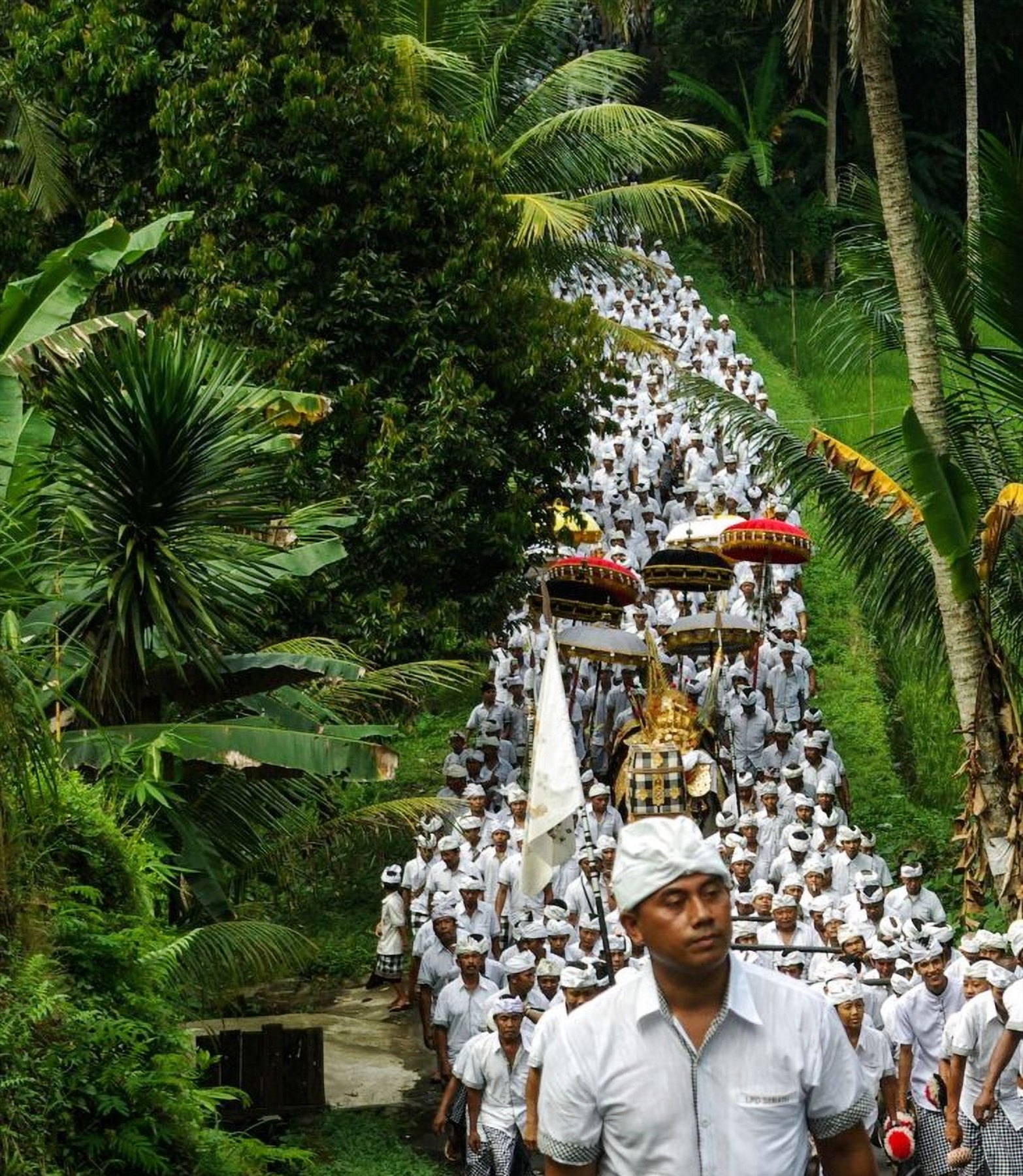
- The procession: On the day, the remains are carried out to the bade, a tall tower, and dozens of men shoulder it toward the cremation ground beside the death temple. At every crossroads they spin it around, shouting and running, to confuse the spirit so it cannot find its way back home.
- The cremation: The remains are transferred into the animal-shaped sarcophagus, a priest blesses everything with holy water, and the fire is lit. The tower and sarcophagus burn together, often in minutes.
- Returning to the sea: The ashes and remaining bone fragments are gathered, placed with offerings in a coconut and carried to the sea or a river.
- After the fire: Later rites, often called nyekah or memukur, purify the soul further so it can be honored as an ancestor in the family shrine. Many families also pray at temples such as Goa Lawah in the following days.
The bade and the lembu
The bade is a multi-tiered tower of bamboo, wood, paper, mirrors and cloth that represents the cosmos, with a stylized cosmic turtle and serpents at its base, the world of humans in the middle and the heavens above. The number of tiers reflects the status of the dead: the more important the person, the taller the tower, with nine-tiered towers used for royal cremations called pelebon. Ubud's royal cremations, with towers rising high above the rooftops, draw enormous crowds.
The lembu is the sarcophagus, most famously a life-size bull built on a wooden frame and covered in painted cloth and gilded ornaments. Other forms exist, including a winged lion (singa) or a tiger (macan), and the shape often reflects the family's descent group. Like the tower, it is beautiful, painstaking work made to be destroyed. That contradiction is the whole lesson.
Mass cremations: Ngaben massal
Because private cremations are so costly, many villages hold collective ceremonies every few years, known as ngaben massal or ngaben ngerit. All the graves in the cemetery are opened, families clean their relatives' bones together, and dozens of bodies are cremated on one day under one set of rituals, with costs shared through the banjar. This can bring a family's cost down to roughly IDR 5 to 10 million per person.
Local governments increasingly help. In 2026, Klungkung Regency's subsidy of IDR 5 million per body supported a collective ceremony for 83 people in Sebunibus on Nusa Penida in August, and Jembrana Regency ran a free mass ceremony in July. These are some of the most moving events you can witness in Bali, and also some of the most public, since the whole village takes part.
Can tourists attend a cremation?
Usually, yes. Large public cremations, especially royal and mass ceremonies, are open to respectful onlookers, and Balinese families generally see a big crowd as an honor that helps send the soul off well. A private family cremation is different: go only if you are invited. Your guesthouse family or driver will often know about cremations coming up nearby, and the bigger ones are announced locally days in advance.
How to behave at a Ngaben
- Dress properly: A sarong and sash at minimum, with shoulders covered. Plain or dark colors are fine; white is often worn by the family.
- Keep your distance: Never walk in front of priests, offerings or the procession, and do not block the path of the tower. When it spins at a crossroads, the crowd moves fast, so stand back.
- Photograph with care: Photography is not forbidden at public cremations, but avoid close-ups of grieving relatives and the remains, never use flash during prayers and leave drones at home unless the family has agreed.
- Stay calm and quiet during prayers: Sit lower than the priest if people around you are seated, and follow what local guests do.
- Expect disruption: Roads close for processions, sometimes for hours, and on small islands even harbors can be affected. Plan around it, not through it.
Frequently asked
Why are Balinese cremations happy?
Balinese Hindus believe cremation releases the soul from the body so it can move on toward rebirth. The ceremony is a celebration of that release, and loud grief is thought to hold the soul back.
Can tourists attend a cremation ceremony in Bali?
Yes, large public, royal and mass cremations are generally open to respectful visitors in proper temple dress. Attend a private family cremation only if you are invited.
How much does a Balinese cremation cost?
A private cremation often costs from around IDR 30 million to over IDR 150 million. Mass cremations shared by a village can bring the cost down to roughly IDR 5 to 10 million per person.
What is the bull in a Balinese cremation?
It is the lembu, a sarcophagus shaped like a bull or another animal that holds the remains and is burned together with the bade tower.

The Sacred Heart of Bali
Offerings, ceremonies, temple festivals and the unseen world that shapes daily life on the Island of the Gods.