Bali's highest mountain, and its holiest
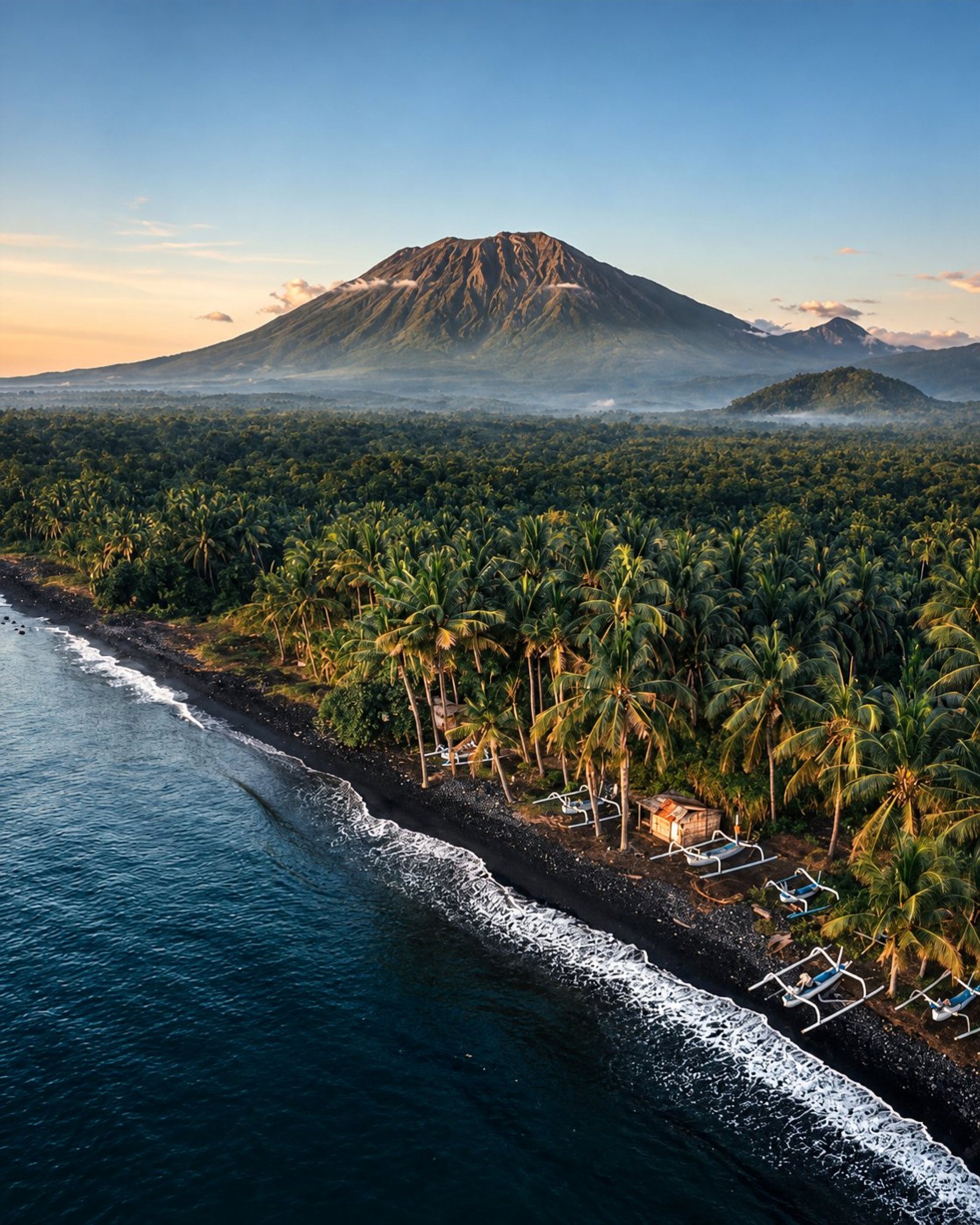
Mount Agung, Gunung Agung to the Balinese, is the highest point on the island at an official 3,031 meters, with the true summit on the far side of the crater often given as around 3,142 meters. It is an active stratovolcano in Karangasem regency in the east, and on a clear morning you can see its near-perfect cone from almost anywhere in Bali, from the rice fields of Sidemen to the beaches of Sanur.
For Balinese Hindus it is far more than a landmark. Agung is the axis of the world, the seat of the gods and the source of the island's holy water. Village shrines and family temples are often oriented toward it, people sleep with their heads pointing in its direction, and the island's mother temple, Besakih, sits on its southwestern slope. You can climb it, with a licensed guide, outside of ceremony closures. But it helps to understand first why the mountain matters so much.
The sacred mountain and Besakih
In the Balinese sense of direction, kaja, toward the mountain, is the pure and sacred direction, while kelod, toward the sea, is the realm of the lower forces. Agung is the ultimate kaja. Legend says it is a piece of the holy Mount Meru, brought to Bali by the gods.
Besakih, at roughly 1,000 meters on the mountain's flank, is a complex of more than 80 temples climbing the slope in terraces. Every year, around the full moon of the tenth Balinese month, it hosts Ida Bhatara Turun Kabeh, a festival lasting several weeks when the gods are believed to descend and gather there, and tens of thousands of pilgrims arrive from across the island.
The 1963 eruption
In early 1963, Agung woke after more than a century of silence, just as Bali was preparing for Eka Dasa Rudra, an enormous purification ceremony held only once a century. Activity began in February, and the main eruption on March 17 sent pyroclastic flows racing down its flanks. Around 1,100 to 1,500 people died in those flows alone, and hundreds more in lahars and a second eruption in May. Ash smothered farmland across the east, and many families were displaced.
The lava stopped just short of Besakih, missing it in places by mere meters, which Balinese people still regard as a sign of divine protection. Many also saw the disaster as a warning that the world was out of balance, and Eka Dasa Rudra was held again, successfully, in 1979.
The 2017 to 2019 eruptions
After decades of quiet, swarms of earthquakes in September 2017 led authorities to declare an exclusion zone of up to 12 km and evacuate more than 100,000 people. Agung finally erupted in late November 2017, sending ash high into the sky and closing Bali's international airport for a few days, stranding thousands of travelers. Smaller eruptions followed through 2018 and into mid-2019.
Since then the volcano has calmed, and by 2026 the official alert level was back at Level I, normal. Activity can change, so check the current status on Indonesia's volcano agency, MAGMA Indonesia, before you plan a climb.
Climbing Mount Agung: the two routes
Pura Pasar Agung route (the classic sunrise climb). This is the shorter and more popular option, starting at Pura Pasar Agung temple above Selat at roughly 1,500 to 1,600 meters. Most groups start walking between 1 and 2 am, reach the crater rim at around 3,000 meters in about 3.5 to 5 hours, and watch sunrise with Mount Rinjani on Lombok floating above the clouds to the east. The trail climbs through forest, then across loose scree and bare rock, with fixed ropes on some steep sections near the top. It does not reach the true summit; from the rim you look across the crater to it. Plan on roughly 8 hours for the round trip.
Besakih route (the true summit). Starting near Besakih temple, this is longer and much harder: around 6 to 8 hours up through forest and over steep, crumbly rock, and often 10 to 12 hours in total. It is the only route to the true summit. Some operators split it into two days, camping high on the mountain and pushing for the top before dawn.
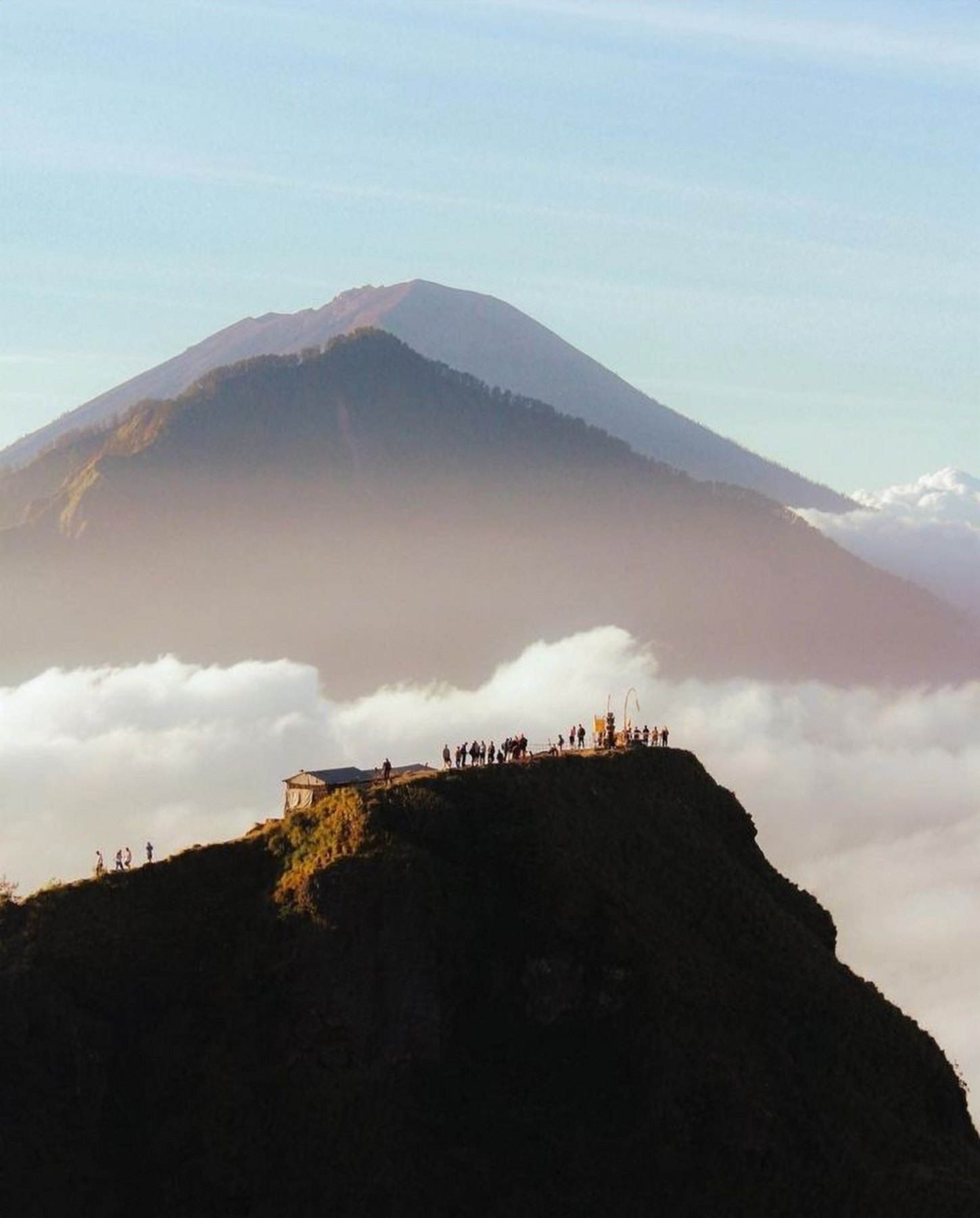
Either way, this is a serious mountain hike with significant elevation gain, not a stroll. Most visitors who are fit but not experienced climbers find Mount Batur, at 1,717 meters, a far easier sunrise trek.
Guides, rules and fees
- A licensed local guide is mandatory. A 2025 circular from Bali's provincial forestry and environment agency requires climbers to hike with a licensed guide, and foreigners who climbed without one have been deported. Register at the posts at Pura Pasar Agung or Besakih, or book through a reputable operator.
- Costs vary widely. A local guide hired directly at the trailhead has been quoted at around IDR 600,000 to 750,000 (about USD 35 to 45), plus an entrance fee reported at around IDR 100,000 for foreigners. Packaged sunrise climbs with hotel transfers usually cost considerably more, and a two-day Besakih trek with camping can run around IDR 3.5 million per person. Confirm what is included.
- Ceremony closures. The mountain closes to all climbing during major ceremonies at Besakih. In 2025 it was closed from April 6 to May 3, and in 2026 from March 28 to April 24, both for Ida Bhatara Turun Kabeh. Other ceremonies can trigger shorter closures, and the dates change every year.
- Weather closures. Climbing is also prohibited during extreme weather and heightened volcanic activity.
- Local customs. By Balinese custom, people considered ritually impure, such as women who are menstruating or anyone recently bereaved, should not climb. Bring no beef, and let your guide make the small offerings at the start and on the rim.
Practical tips for the climb
- Best season: The dry season, roughly April to October, gives the best chance of clear skies and firmer trails. In the wet season, rain makes the rock slippery and views less certain.
- Pickup times: Expect hotel pickups around 11 pm from Kuta or Seminyak and around midnight from Ubud, with a drive of two hours or more. Staying in Sidemen or near Selat the night before cuts that down considerably.
- What to bring: Proper hiking shoes with good grip, a headlamp, warm layers and a windproof jacket (it can be near freezing on the rim before dawn), gloves for the ropes and scree, at least two liters of water and snacks.
- Pacing: Knees take a beating on the descent. Trekking poles help.
- Combine it with: A visit to Besakih on another day, the Lempuyang temple viewpoint with Agung framed behind its gates, or a slow afternoon in the Sidemen valley looking up at the mountain you just climbed.
Frequently asked
How high is Mount Agung?
Mount Agung's official height is 3,031 meters, the highest point in Bali. The true summit on the far side of the crater is often given as around 3,142 meters.
Do you need a guide to climb Mount Agung?
Yes. Since 2025 a licensed local guide is mandatory, and foreigners caught climbing without one have been deported.
When is Mount Agung closed to climbers?
It closes during major ceremonies at Besakih, usually for several weeks around March or April, and during extreme weather or volcanic unrest. In 2026 it was closed from March 28 to April 24.
Is Mount Agung harder than Mount Batur?
Much harder. Agung involves about 1,500 meters of climbing over steep, loose terrain and takes around 8 to 12 hours, while Batur is a 2 to 3 hour climb to the top.

Гора Agung
Самый высокий и самый священный вулкан Бали: восхождения, храмы на его склонах и как спланировать трек.