Bali's history at a glance
Bali's story runs from Austronesian rice farmers to Hindu-Javanese courts, from a cluster of rival kingdoms to Dutch conquest, and from Indonesian independence to mass tourism. The short version: an early island culture absorbed Indian ideas through Java, was reshaped by the Majapahit empire in the fourteenth century, became the last great Hindu refuge when Java turned to Islam, fell to the Dutch in a series of brutal campaigns ending in 1908, and has spent the last century balancing faith, politics and outsiders' fascination. Here is how it unfolded.
The first Balinese and the Bali Aga
People lived on Bali long before any written record; stone tools have been found near Sembiran and Trunyan. Around 3000 to 600 BCE, Austronesian migrants arrived with rice cultivation, the foundation of everything that came later. Bronze working followed, and one of Southeast Asia's great Bronze Age objects, the Moon of Pejeng, a huge kettle drum, still hangs in a temple near Ubud.
The descendants of these early communities are known as the Bali Aga, though many prefer Bali Mula, original Balinese. Villages such as Tenganan in the east and Trunyan on Lake Batur kept customs older than the Javanese influence that shaped most of the island. Tenganan still weaves geringsing double-ikat cloth, and Trunyan does not cremate its dead but lays them beneath a sacred tree.
Indian ideas, Javanese kings
Hindu and Buddhist ideas reached Bali through trade and through Java. The earliest dated record is the Belanjong pillar in Sanur, inscribed in 914 CE under King Sri Kesari Warmadewa, founder of the Warmadewa line. Around the end of the tenth century, King Udayana married the Javanese princess Mahendradatta, and their son Airlangga went on to rule in East Java. The two islands' courts were now bound by blood, and the cave sanctuary of Goa Gajah and the rock-cut shrines of Gunung Kawi date from roughly this era.
Majapahit and the Gelgel golden age
The turning point came in 1343, when Gajah Mada, the great general of the Majapahit empire, defeated the Balinese king at Bedulu. Majapahit nobles, priests and administrators settled on the island, bringing a caste structure, court arts and a Hindu-Javanese worldview that still define Balinese culture. The Bali Aga villages that resisted kept their older ways.
When Majapahit collapsed around the end of the fifteenth century as Islam spread across Java, many Hindu Javanese aristocrats, priests and artists fled east. Bali became the keeper of a civilization that had vanished on its neighbor. Under Dalem Waturenggong in the sixteenth century, the Gelgel kingdom near today's Klungkung ruled Bali and reached into Lombok and parts of East Java. This was also the age of the priest Dang Hyang Nirartha, credited with founding temples such as Uluwatu and Tanah Lot.
Rival kingdoms and Dutch conquest
In the late seventeenth century the royal seat moved to Klungkung, and Bali gradually splintered into nine kingdoms: Klungkung, Badung, Gianyar, Tabanan, Bangli, Karangasem, Buleleng, Jembrana and Mengwi. Rivalry between them gave the Dutch, who had first arrived in 1597, their opening.
Military expeditions in the 1840s brought Buleleng and Jembrana in the north and west under Dutch control. The south held out until the early twentieth century. In 1904 a Chinese schooner, the Sri Kumala, ran aground off Sanur and was plundered, and the king of Badung refused Dutch demands for compensation. On September 14, 1906, Dutch troops landed at Sanur and marched on Denpasar.
What happened on September 20, 1906, still shapes how Bali remembers itself. Rather than surrender, the raja of Badung, dressed in white and followed by his court, priests, women and children, walked straight into Dutch gunfire in a puputan, a ritual fight to the end. At least 1,000 people died in Denpasar alone, with another puputan at Pemecutan the same afternoon. On April 28, 1908, the Dewa Agung of Klungkung led a final puputan, and Dutch control of Bali was complete. Puputan Square in Denpasar, with its bronze monument, stands where the Badung palace once was.
Paradise, occupation and independence
The Dutch, embarrassed by international outrage, began promoting Bali as a living museum of culture. The island opened to tourism in 1914, and in the 1930s artists and writers such as Walter Spies helped build the image of Bali as paradise.
Japanese forces landed at Sanur in February 1942 and occupied the island until 1945. When Indonesia declared independence, the Dutch tried to return. The young officer I Gusti Ngurah Rai led Balinese resistance until he and his men were killed at the Battle of Margarana on November 20, 1946. Bali's airport now bears his name. The Netherlands recognized Indonesian independence in 1949, and Bali became its own province in 1958.
Eruption and the dark years of 1965-66
In 1963, Mount Agung erupted after more than a century of quiet, killing well over a thousand people and devastating farmland in the east. Many Balinese read the disaster, which came during a huge purification ceremony at Besakih, as a sign that the world was out of balance.
Two years later came the darkest chapter in modern Balinese history. After a failed coup in Jakarta in 1965, a wave of anti-communist violence swept Indonesia. In Bali, an estimated 80,000 people were killed in a few months, around five percent of the island's population at the time, often by neighbors and within villages. It was barely discussed in public for decades, and many families still carry it quietly. It is worth knowing about, and worth not raising casually with people you meet.
The tourism era
From the late 1960s, under Suharto's New Order, tourism became the island's economic engine. Sanur got Bali's first big international hotel, then Kuta grew from a fishing village into a surf town, and by the early 2000s more than a million foreign visitors were arriving each year. The 2002 Kuta bombings, which killed 202 people, and a second attack in 2005, hit hard, as did the pandemic years when international arrivals all but stopped.
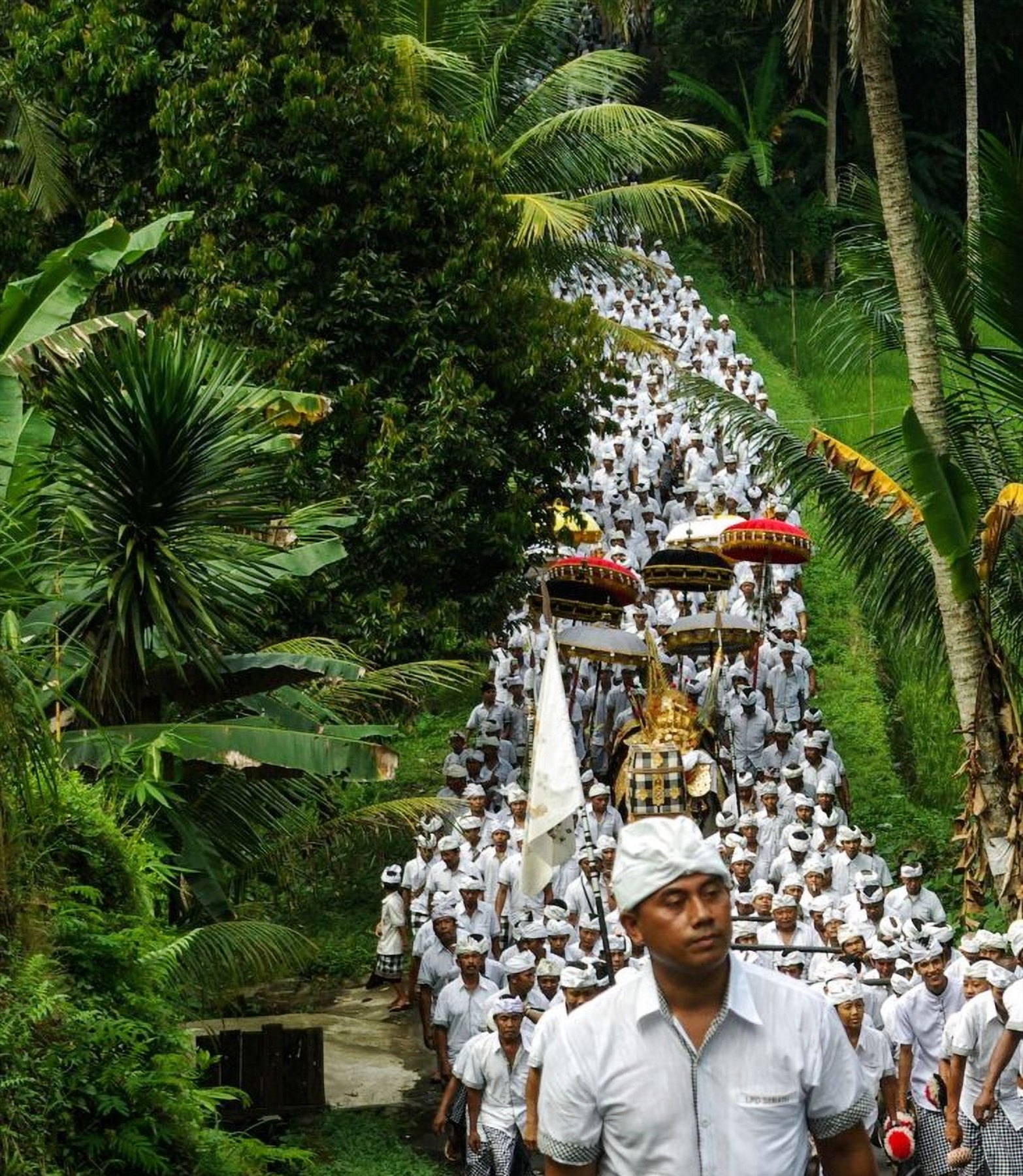
Each time, Bali recovered, and today it faces newer pressures: traffic, water shortages, waste and the loss of rice fields to villas. Yet walk into any village on a temple festival day and you see the thread that runs through all of this history. Kingdoms rose and fell, colonizers came and went, and the offerings still go out every morning.
Frequently asked
Why is Bali Hindu when the rest of Indonesia is mostly Muslim?
Bali was shaped by the Hindu-Javanese Majapahit empire, and when Java converted to Islam in the fifteenth and sixteenth centuries, many Hindu nobles, priests and artists fled to Bali, which kept the faith.
What was the puputan in Bali?
A puputan is a ritual fight to the death chosen over surrender. The royal courts of Badung in 1906 and Klungkung in 1908 marched into Dutch fire, ending Balinese independence.
When did Bali become part of Indonesia?
Indonesia declared independence in 1945, the Netherlands recognized it in 1949, and Bali became a separate province in 1958.
Who were the Bali Aga?
The Bali Aga, or Bali Mula, are descendants of the island's pre-Majapahit inhabitants. Villages such as Tenganan and Trunyan still keep older customs.

The History of Bali
From the first kingdoms and the arrival of Majapahit to colonial conquest, the puputan and the island's modern reinvention.